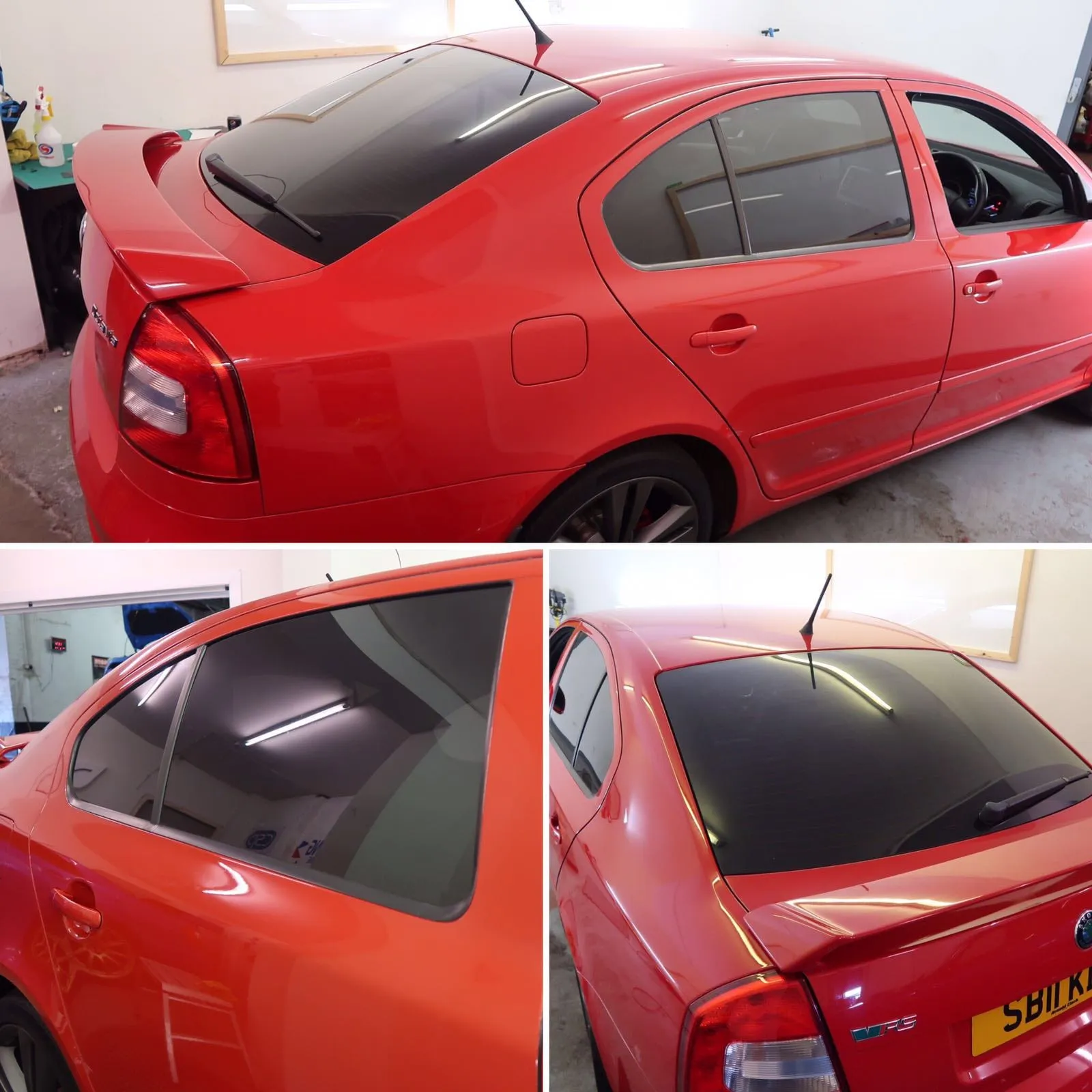
Is window tint legal in the UK? Yes, on most of the car, and no, on the bit people usually want it. Two numbers cover almost every question, and which side of the B-pillar the window sits on answers the rest. Here’s the law as it stands, what it means once the film is on the glass, and what actually happens if you get it wrong.
The law, in one table
UK law sets a minimum amount of light that must pass through the glass, called visible light transmission, or VLT. It only applies to the glass in front of the driver’s line of sight. Everything behind the B-pillar (the post between the front and rear doors) has no legal limit at all.
| Window | Minimum light through | What that means in practice |
|---|---|---|
| Front windscreen | 75% | Almost no aftermarket film is legal here beyond a sun strip at the top, above the wiper sweep. |
| Front side windows | 70% | Only a very light film, and the maths below matters because factory glass is never 100%. |
| Rear side windows | No limit | As dark as you like. Privacy, heat and glare films are all fine. |
| Rear windscreen | No limit | As dark as you like, provided you have working exterior mirrors on both sides, which every modern car has. |
These figures apply to vehicles first used on or after 1 April 1985, which is every car you’re likely to be tinting. Older vehicles have a 70% minimum on the windscreen too. The rules come from the Road Vehicles (Construction and Use) Regulations 1986.
The short version: front, effectively no tint. Behind the driver, anything goes.
Why a “70% film” on a front window is usually illegal
This is the bit nobody explains. The 70% rule is measured through the glass and the film together, and factory glass already blocks some light, so the film’s rating is never the finished number.
Ordinary clear car glass lets through roughly 80 to 85% of light. Put a film rated at 70% on top and the light that gets through is the two multiplied together: 0.82 for the glass times 0.70 for the film gives about 57%. That’s illegal on a front side window, even though the film itself says 70% on the box.
To stay above 70% through the finished window, the film has to be very light, typically rated 85 to 90% VLT. Those films exist and do a real job on heat and UV. They just don’t look tinted, which is exactly why some installers quietly fit something darker. The customer gets the look they asked for and the problem six months later.
Factory privacy glass and “matching the rears”
Many vans, SUVs and estates come with dark rear glass from the factory, often around 20% VLT. That’s legal, because it’s behind the B-pillar. It’s also why asking to match the rears on the front doors is a trap: you’d be trying to hit 20% where the law demands 70%. The honest answer is that the fronts stay light and the rears can match whatever the factory did.
What good film does within the law
- Heat and glare. The rear cabin can take a proper solar film. The front gets a clear or near-clear heat-rejection film that stays well inside the limit.
- UV. Quality films block 99% of UV regardless of how dark they are, so the light front film protects skin and trim as well as the dark rear one does.
- Privacy. The back of the car is, legally, yours to make private.
Our vehicle tinting page sets out the film options by window, with the fronts kept legal as standard.
What happens at an MOT
Tint levels aren’t measured with a meter as part of the standard MOT test. A tester can still fail the car if the windscreen or front side windows are obviously tinted enough to reduce the driver’s view. It’s a visual judgement, and a heavily tinted front will not pass it. A legal rear tint is never an MOT issue.
What happens at the roadside
Police and DVSA officers do carry light meters. If the front glass measures under the limit, the usual outcomes are:
- A prohibition notice: the vehicle can’t be driven until the film is removed and it’s re-checked.
- A fixed penalty, or in more serious cases a summons for driving a vehicle in a dangerous condition.
- An insurer treating undeclared illegal tint as a modification, which can matter far more than the fine if there’s a claim.
Removing film from a front window is a job in itself: adhesive residue, the risk of damaging heated-screen elements, and the cost of doing it properly. Getting it right first time is cheaper in every direction.
Our position is simple. We fit whatever you want behind the B-pillar and we keep the fronts legal. Not “probably fine”, legal. If someone offers you 35% on the front doors of a 2019 car, they’re offering you a prohibition notice with extra steps.
Five questions before any film touches the glass
- Which windows, exactly? Front sides and windscreen stay inside 70% and 75% through the finished glass.
- What’s the film’s VLT rating, and what’s the finished number once it’s on the glass?
- Which manufacturer is the film from, and is the installer accredited by them? A warranty is only worth what the manufacturer will honour.
- Is the warranty against bubbling, peeling and turning purple in writing? Ours is lifetime on automotive tint.
- How long before you can wind the windows down? Usually a couple of days while it cures.
The full checker, with the table and the questions in a printable form, is a free download on our guides page.
Get a real number
Pick your car on our vehicle tinting page and the estimator gives you a price straight away: from £109 for a small 3-door hatch or a panel van, fitted, with the front windows kept legal as standard. We’re accredited installers for 3M, LLumar, XPEL and Suntek tint film, based in Harrogate and covering Leeds, York and Bradford.
This article describes UK law as it stands in 2026 in plain English for drivers. It isn’t legal advice; the regulations, not this page, are what applies at the roadside.
More on this service: Vehicle window tinting